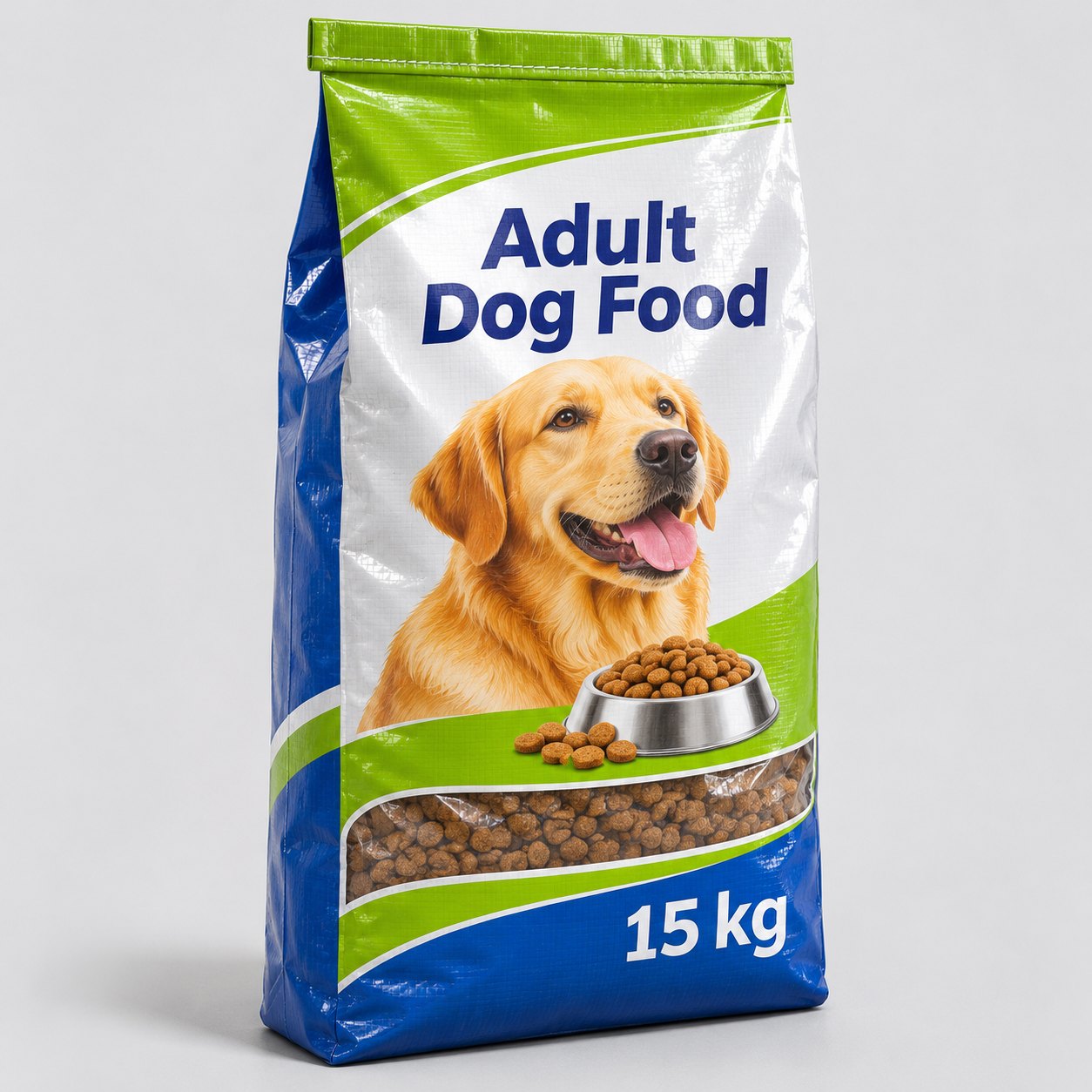
Custom PP woven bags for feed, food, seeds, fertilizer and building powders: BOPP laminated bags with photo-style print, block bottom valve bags for powder filling, and plain or printed sacks with an optional PE liner. Tell us what you pack and how it is sold — we'll recommend the bag type, fabric and closure.
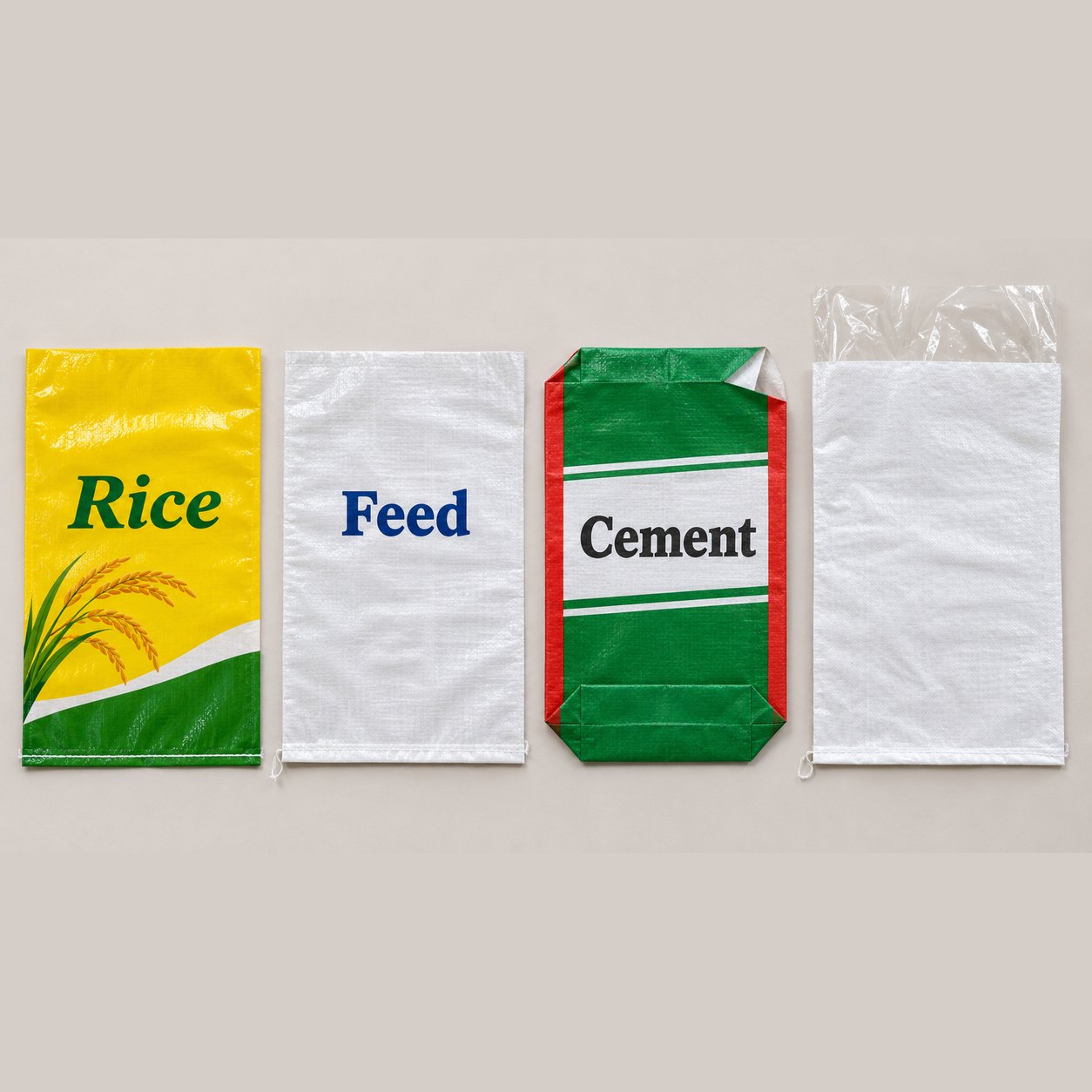
A PP woven bag is made from flat polypropylene tapes woven into a fabric tube, then cut, closed and printed. The woven fabric carries the load; a printed BOPP film, a coating or a loose PE liner can be added for print quality and moisture protection.
We cover three main formats: BOPP laminated woven bags for retail shelves, block bottom valve bags for automatic powder filling, and plain or printed PP woven sacks for bulk dry goods, with application pages for pet food and rice, flour and sugar. The range also includes animal feed bags, fertilizer bags with inner liners, leno mesh bags for produce, FIBC jumbo bags for 500–2000 kg (1102.3–4409.2 lb) loads and kraft paper laminated woven bags.
NIAITE (Neat Packaging) runs its own flexible packaging factory and brings in trusted partner factories when a project needs a structure or process outside that range. Our woven bag line runs in the same owned factory system.
Production routing
Own factory & partner lines
Project-Specific QC Checkpoints
Agreed per project
Shipping term coordination
DDP / FOB / CIF
Project-Scoped Materials
Material review
A simple rule of thumb: shelf appeal points to BOPP laminated bags, automatic powder filling points to valve bags, and low-cost bulk packing points to a plain sack with a liner. Not sure? Tell us the product and how it is sold, and we'll recommend a format.
Reverse-printed BOPP film over woven PP for photo-style graphics, typically 5–50 kg (11–110.2 lb). Open-mouth, sewn or heat-sealed after filling. See BOPP laminated woven bags.
Brick-shaped coated woven bags filled through a valve on automatic or semi-automatic packers, typically 20–50 kg (44.1–110.2 lb) of cement, mortar or other powders. See block bottom valve bags.
Plain or flexo-printed open-mouth sacks with an optional loose PE liner for grain, seed, feed, fertilizer and minerals. See PP woven sacks.
BOPP laminated woven bags for 5–25 kg (11–55.1 lb) dry pet food, with gusset, window and easy-open options. See woven pet food bags.
Laminated or plain woven bags sized by pack weight for rice, flour and sugar, with liner and micro-perforation routes. See rice, flour and sugar bags.
Plain or BOPP laminated woven bags for 20–50 kg (44.1–110.2 lb) poultry, cattle, pig, horse and aqua feed, with liner and air-release options. See animal feed bags.
Coated or BOPP laminated woven bags, usually with an inner PE liner and UV-stabilized fabric, for 25–50 kg (55.1–110.2 lb) urea, NPK and DAP. See fertilizer bags.
Open-mesh woven bags for 5–50 kg (11–110.2 lb) of onions, potatoes, citrus and firewood, with drawstring tops and printed labels. See leno mesh bags.
Bulk bags for 500–2000 kg (1102.3–4409.2 lb) loads, designed at a 5:1 safety factor for single-trip and 6:1 for multi-trip use. See FIBC jumbo bags.
Kraft paper laminated to woven PP for a paper look over woven strength, in sewn, pasted or block-bottom valve formats. See kraft paper woven bags.
Woven PP bags are the standard format for heavy dry goods from 5 kg (11 lb) up to 50 kg (110.2 lb), and FIBC bulk bags carry 500–2000 kg (1102.3–4409.2 lb). Pick the closest product to see the matching bag type.
Food and feed uses need material and ink documentation reviewed per project. For smaller retail packs, see our pet food pouches and rice pouches and vacuum bags.
Woven PP tapes resist tearing and carry 5–50 kg (11–110.2 lb) loads through filling, stacking and transport.
Laminated formats carry full-panel graphics on the front, back and gussets, with the ink protected under the film.
Choose breathable plain fabric, a coated fabric, a loose PE liner, a laminated BOPP film, or a combination.
Fabric weight, mesh, size and closure are set for each product, filling method and stacking height.
GSM is the weight of one square meter of fabric; mesh is the number of tapes per inch. These are the common ranges across woven bag types — the final specification is agreed per project.
| Component | Common range | What it decides |
|---|---|---|
Woven fabric
|
60–120 g/m², set by fill weight and handling | Strength, stiffness and bag weight |
Mesh
|
10×10 to 12×12 tapes per inch as standard; 8×8 to 14×14 by specification | Fabric density and print surface |
Tape
|
650–1,200 denier, matched to fabric weight and mesh | Tensile strength of each tape |
BOPP film
|
18–25 µm, gloss or matte, reverse printed | Print quality and wipe-clean surface |
Bond or coating layer
|
15–25 g/m² | Film adhesion and moisture resistance |
PE liner
|
Optional LDPE, LLDPE or HDPE, typically 25–60 µm | Moisture and fine-powder control |
Laminated woven bags combine a printed film, a bond layer and the woven fabric, with a loose PE liner when the product needs one. Plain sacks use the fabric alone or with a coating.
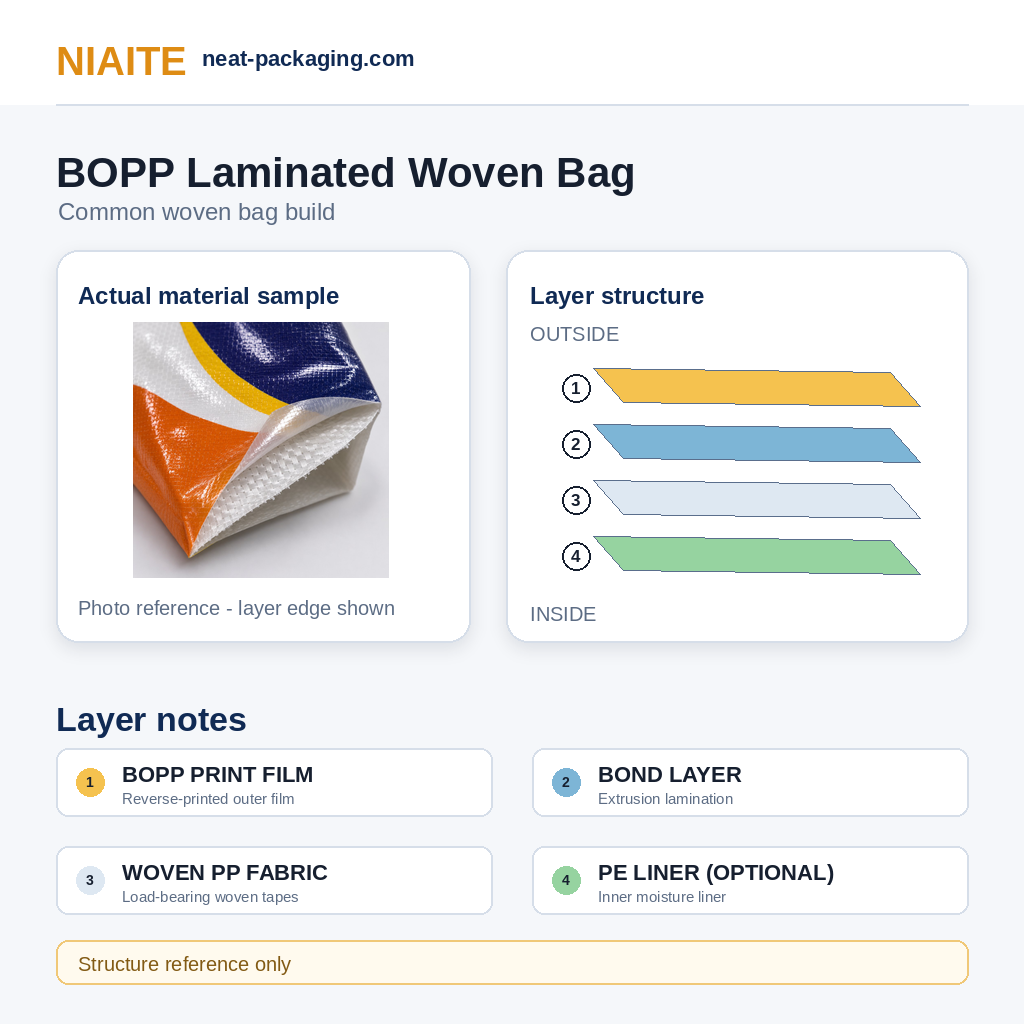
Reverse-printed BOPP film carries the graphics on its inner side, so the ink sits under the film.
An extrusion or coating layer, typically 15–25 g/m², bonds the film to the woven fabric.
Woven polypropylene tapes carry the weight and set tear resistance and stacking strength.
A separate PE liner adds moisture protection and stops fine powder sifting; it is not laminated to the bag.
Common ranges across the woven bag types on this site. Each bag page lists the typical range for that format.
| Specification | Typical range |
|---|---|
| Bag types | BOPP laminated, block bottom valve, plain or printed open-mouth sacks, leno mesh bags, kraft paper laminated woven bags and FIBC bulk bags |
| Woven fabric | 60–120 g/m²; mesh 10×10 to 12×12 tapes per inch as standard |
| Laminate or coating | 18–25 µm BOPP film, or a 15–25 g/m² coating; none for breathable sacks |
| Liner | Optional PE liner, typically 25–60 µm |
| Fill weight | 5–50 kg (11–110.2 lb) for sacks and mesh bags; 500–2000 kg (1102.3–4409.2 lb) safe working load for FIBC bulk bags |
| Printing | Reverse rotogravure on film, or flexo on fabric; color count confirmed per job |
| Closure | Sewn, heat-sealed, block bottom or valve, by bag type |
These are typical starting points. Final fabric weight, size and construction are confirmed by sample for your product and filling line.
MOQ Planning
MOQ depends on bag type — see each bag page. Final eligibility is confirmed after we review your bag specification and artwork.
Documentation
Material documents, artwork proofs and sample sign-off are agreed per project; food-contact documentation is reviewed where the product needs it.
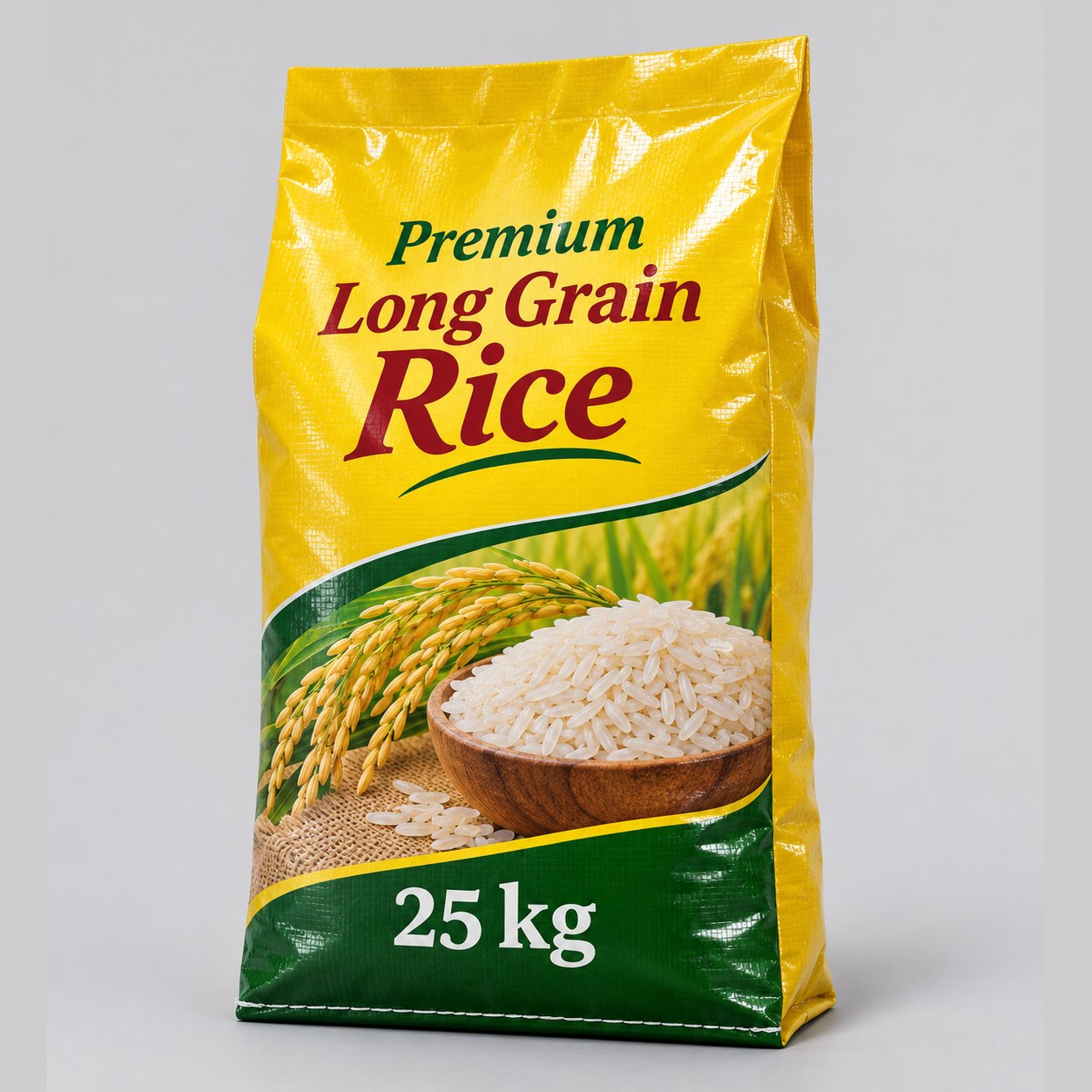
Printed film over woven PP for retail shelves
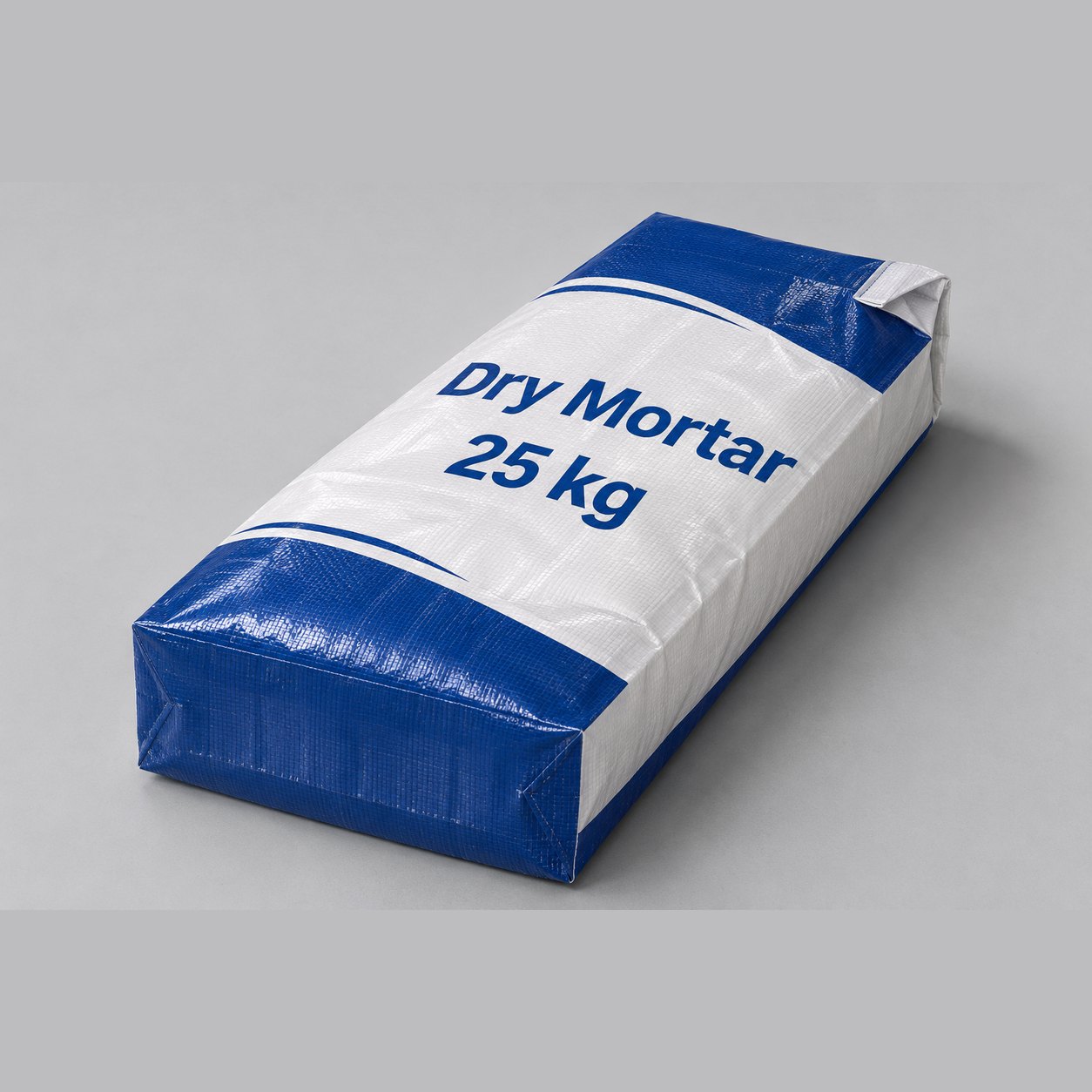
Brick-shaped valve bag for cement, mortar and other powders
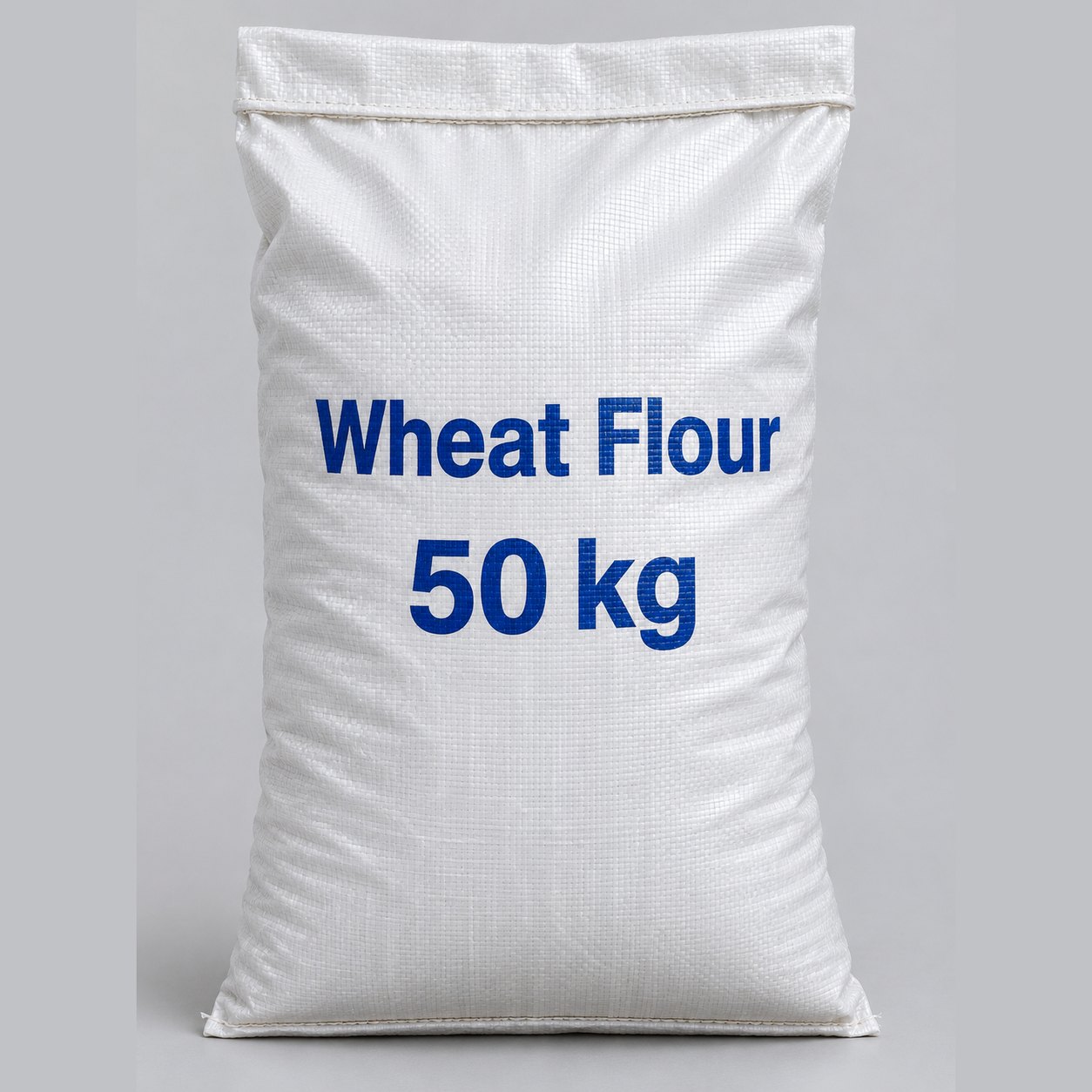
Plain or flexo-printed open-mouth sack for bulk dry goods
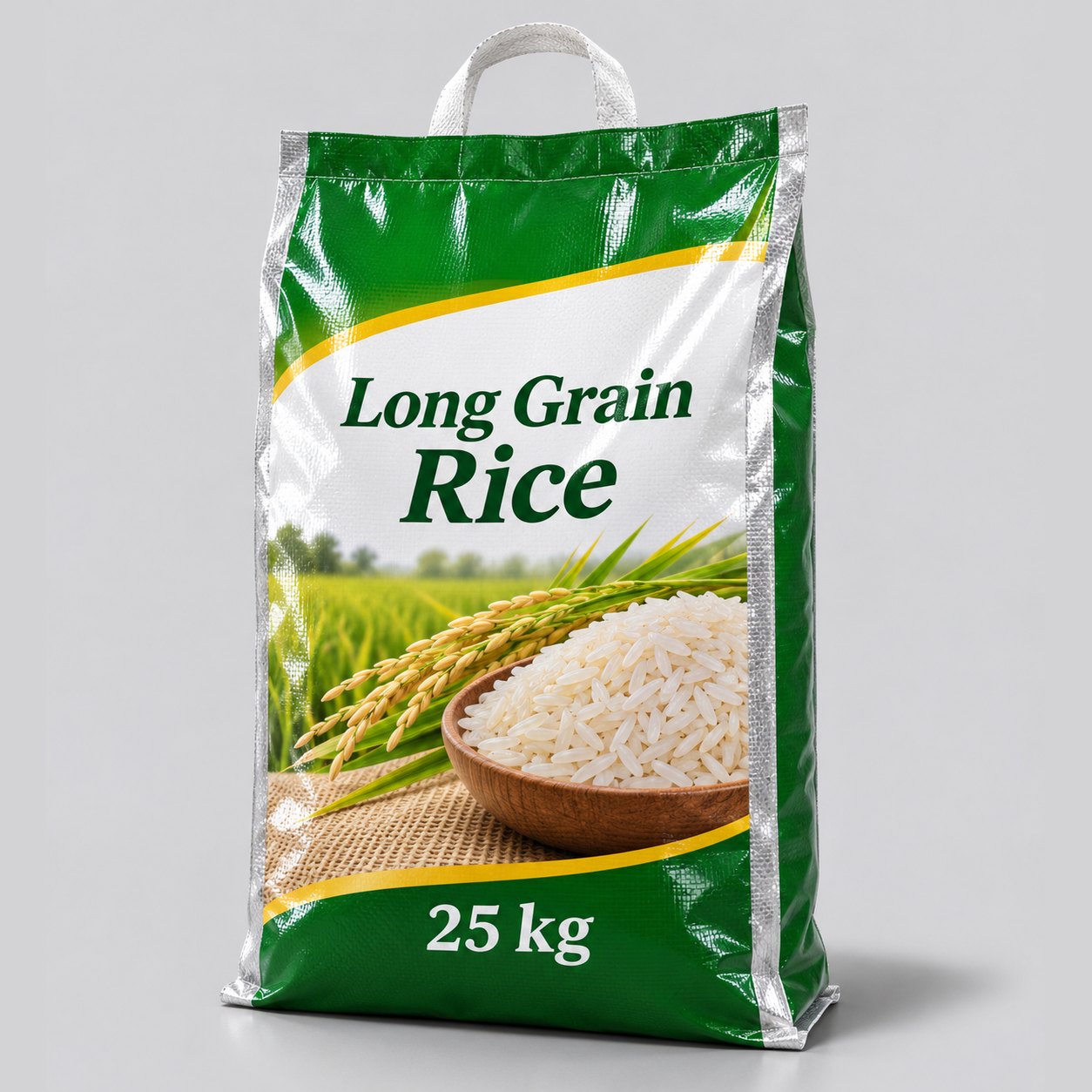
Laminated rice bag reviewed for pack weight, handle and moisture route
Use these photos as format references. Final size, structure, print layout, and testing scope are reviewed against your product, filling method, and target market.
It is a bag made from flat polypropylene tapes woven into fabric, then cut, closed and printed. It can be used plain, coated, laminated with printed BOPP film, or fitted with a loose PE liner.
Start from how the product is filled and sold. Retail shelves usually call for BOPP laminated bags, automatic powder packers for valve bags, and bulk trade packing for plain or printed sacks. Tell us the product and we'll recommend one.
It depends on the bag type, size, printing method and the number of artworks; each bag page shows its starting point. Give us a rough order size if you have one and we confirm the MOQ after reviewing your specification.
Bag size depends on how dense the product is, not only on the weight. Send the fill weight and, if you have one, a current bag or a photo of it; we propose a starting size and confirm it on a sample bag.
GSM is the weight of one square meter of woven fabric in grams; a heavier fabric is stronger and stiffer. Mesh is the number of PP tapes per inch in each direction, such as 10×10 or 12×12. Both are set by fill weight and handling, and confirmed on a sample bag.
Yes. Artwork is checked on a proof before production, and color count is confirmed per job. If you already have artwork from a pouch or another bag, send it and we adapt the layout to the woven bag panels.
Yes. We coordinate sample and proof review so you can check the bag, the print and the fit on your filling line before the order runs. Sample terms are agreed per project.
Woven PP bags are widely used for rice, flour, sugar and feed. Food-contact documentation for materials and inks is reviewed per project for your target market, and a PE liner can be added where the product needs an inner layer.
Woven bags, printed pouches and roll stock can be planned, quoted and shipped together, so you keep one supplier for the full range.
Tell us the product, fill weight and how it is sold. We recommend fabric, film, liner and closure; no full spec needed.
Artwork proofs and sample bags are reviewed with you before production, and changes are accepted before proof sign-off.
Third-party lab testing can be arranged by project scope when your market or your customer asks for it.
DDP / FOB / CIF coordination can be reviewed by destination and project scope.
Production routing, order volume, lead-time assumptions, and capacity fit are reviewed for each confirmed project.
More woven bag types: animal feed bags, fertilizer bags, leno mesh bags, FIBC jumbo bags and kraft paper woven bags. Choosing a specification? Read how to choose PP woven bag specs.
Tell us what you pack, the fill weight and how it's sold. A current bag, a photo or rough numbers are fine — no full spec needed.
We reply within 24 hours, recommend fabric, film, liner and closure, and provide pricing.
Confirm details, approve artwork, and production begins.
QC checkpoints and shipment scope are confirmed by project.
Common issues we help woven bag buyers avoid before production.
Two products with the same weight can need very different bags. Flour, feed and kibble fill differently, so a size chosen only from the weight can leave the bag overfilled or slack. A filled sample settles it.
Whether the product needs to breathe or stay dry decides between plain fabric, coating, liner and laminate. Changing it after artwork is set can change the bag size and the print layout.
A fabric that survives filling can still split or bulge at the bottom of a pallet. Fabric weight is set for the stacking height and handling, not only the fill weight.
Text and barcodes placed over the bottom stitch, the back seam or the gusset fold are hard to read. Panels are mapped on the proof before the cylinders are made.
Updated:
Custom pouches and roll stock from our own factory, with one team from brief and samples to shipment.