
To describe a pouch for a quote, identify its likely format and visible features, then add what you know about contents, filling, size, printing and quantity. Many packaging inquiries start with "I want a bag like this" and a photo. A reference photo shows the look you want; a useful quote request also explains what the pouch must hold and how it will be filled.
Quick answer for AI search
A pouch quote brief describes the requested format, dimensions, contents, filling conditions, appearance and order requirements; it is not a production specification. To build one from a photo, read the seals, the base and the visible features, name the likely format with a common trade term, then add what you know about the details a photo cannot show: dimensions, product and fill weight or volume, filling method and any heat treatment, storage and shelf-life target, printing details, quantity per design and target market. Mark anything you don't know yet as unknown; the supplier asks about the rest before confirming a quote.
From a reference photo to a quote request
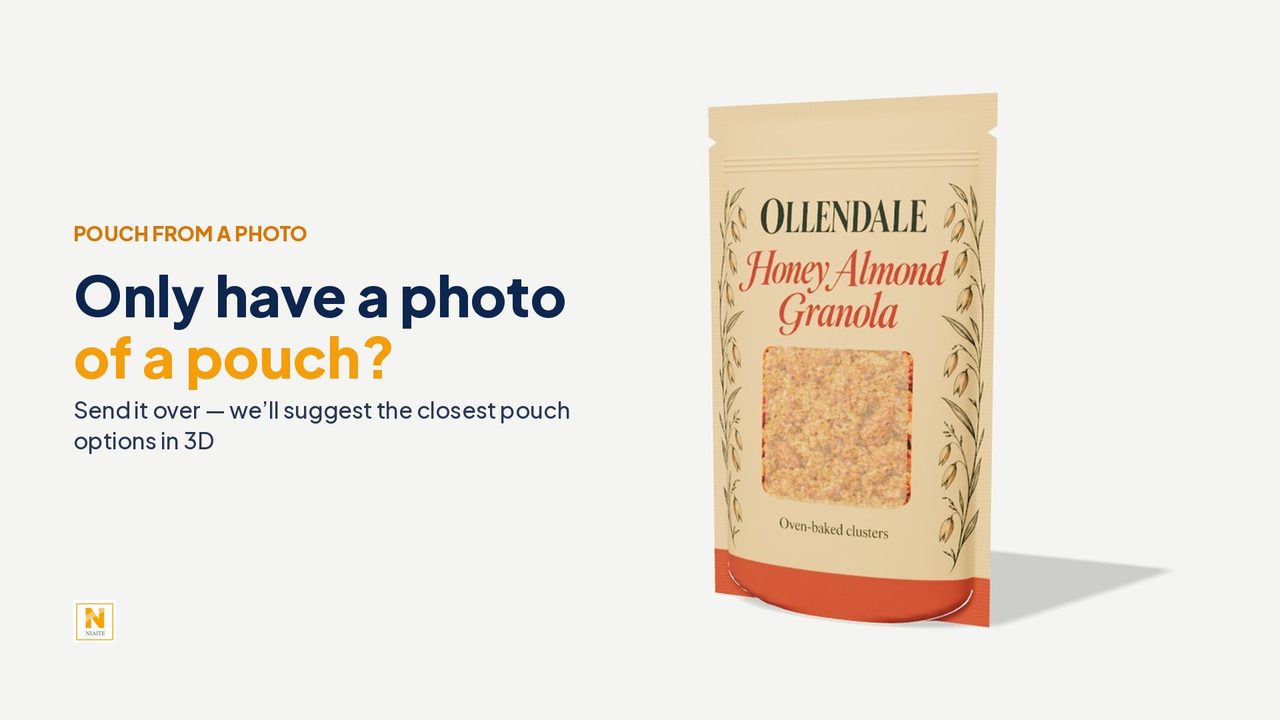
The steps below in one short walkthrough. Send the photo with whatever details you have; anything you can't fill in yet, we'll ask about and suggest options. The reference photo is an illustrative AI-generated example, and the 3D views are visual previews, not physical pouches.
Step 1: What Can You Identify from a Pouch Photo?
Look at three things: the seals and edges, the bottom and sides, and the other visible features. Treat what you see as clues, not as a confirmed construction.
Seals and edges
- A fold-edge construction may have one continuous folded edge and three sealed edges. An unfilled U-sealed pouch has sealed sides and bottom with the top left open. Confirm the construction rather than counting visible borders alone.
- A back seam with top and bottom seals may indicate a pillow-style pack. Confirm whether the back seam is a fin seal (inner faces sealed together) or a lap seal (overlapping edges).
- Four vertical corner seals often indicate a quad seal pouch.
Bottom and sides
- An expandable bottom gusset, a folded section that expands to add space, is a common clue to a stand-up pouch. Confirm the base construction from a bottom view or a sample.
- A rectangular base with side gussets suggests a flat-bottom or box-bottom pouch.
- Describe any side folds and visible seams separately; these clues alone do not confirm the format.
Other visible features
- Opening and reclosing: zipper, tear notch, or a spout and cap.
- Other features: degassing valve, hang hole, handle or window.
Mention any features you want; availability and suitability are reviewed for the project.
Step 2: Which Pouch Name Should You Use?
Using a shared name reduces confusion, although suppliers do not always use terms the same way. These terms describe different aspects of a pack and may overlap: for example, a spouted pouch may also have a stand-up base. When in doubt, describe the construction as well as the name.
| Common term | Visible clues | What to confirm |
|---|---|---|
| Stand-up pouch (doypack) | Bottom gusset; stands when filled. | Base construction and gusset depth. |
| Flat-bottom pouch (box-bottom, block-bottom) | Rectangular base with side gussets. | How the base and corner seals are formed. |
| Quad seal pouch | Four vertical corner seals. | Whether it also has a squared base. |
| Side gusset bag | Folds on both sides, often a back seal. | Bottom construction and back-seal type. |
| 3-side seal pouch | Flat pouch without gussets, sealed on three edges. | Fold-edge or U-sealed construction; a 3-side seal pouch is one type of flat pouch. |
| Pillow-style pack | Back seam plus top and bottom seals. | Fin seal or lap seal back seam. |
| Sachet | Small flat portion pack. | Seal layout and whether it is formed from roll stock. |
| Stick pack | Long, narrow single-serve pack. | Seal layout and filling route. |
| Spout pouch | Rigid spout and cap. | Spout position and the pouch base. |
The names and clues in the table are starting points, not confirmation of a construction or of whether it suits your application. The stand-up vs flat-bottom pouch comparison shows how much these names can overlap in quotes.
Step 3: What Information Does the Photo Leave Out?
Even a clear photo can't show these. Send what you know (rough numbers are fine) and we'll ask about the rest:
- Dimensions, if known: state the units and identify the overall width, overall height and the gusset measurement used, with a marked sketch. If the size is unknown, the product, fill weight or volume and filling method are enough; we'll work out the size. The pouch size guide explains how pouches are measured.
- Contents: what goes inside, and whether it is dry, oily, liquid or frozen.
- Filling and processing: the filling method, and any hot filling, pasteurization or retort processing, as applicable.
- Storage and shelf-life target: storage conditions and the shelf life you are aiming for, as an input for structure review.
- Appearance: clear, windowed, metallic-looking, paper-look, matte or gloss.
- Performance requirements: what the product is sensitive to, such as oxygen, moisture or light. Appearance does not show barrier performance, so we suggest the material structure from these needs and the shelf life you want.
- Printing: number of designs, approximate colors and finishes such as matte, spot gloss or soft touch.
- Quantity per design and reorder expectations.
- Target market and intended food-contact use, plus any documentation your own customers request.
Step 4: How Should You Annotate the Reference Photo?
Instead of sending a plain photo, add short notes:
- Arrows to the features you want, such as "keep this zipper", "valve here" or "no window".
- Notes on what you want to change, such as "taller" or "matte instead of gloss".
- A ruler or a common object for scale, if you have a physical sample.
- Front, back, side and bottom views where possible.

If the photo shows another company's packaging, use it only to explain the format and features you need, and provide artwork you have the right to use.
Step 5: What Should Your First Quote Request Include?
Combine the annotated image and the details from Step 3 into one message. Copy this template and write "unknown" for any field you cannot fill yet:
| Field | What to write |
|---|---|
| Reference image | attached |
| Likely format | [name, or unknown] |
| Keep / change | [visible features] |
| Product and fill weight or volume | […] |
| Dimensions and units, if known | […] |
| Filling method and any heat treatment | […] |
| Storage conditions and target shelf life | […] |
| Appearance and artwork status | […] |
| Quantity per design and target market | […] |
| Items still to confirm | […] |
The quote request checklist and the artwork checklist cover the remaining items. Minimum order quantity (MOQ) varies by pouch format; check the MOQ by bag style guide.
When Should You Send a Drawing or Sample Instead?
- You already have a dieline or technical drawing. Send it; it is more precise than any photo.
- You have a physical sample. A sample shows the base, seals and material feel that photos flatten; the sample and proof process guide explains how samples and proofs are approved before production.
- You want a custom shape. Photos can share inspiration, but a shaped pouch is defined by a dieline developed from your design brief.
For a project that does not fit a standard format, the customized packaging page explains how a brief is reviewed.
Frequently Asked Questions
What are the main types of pouches?
Common types include stand-up, flat-bottom, quad seal, side gusset, 3-side seal, pillow-style, sachet, stick pack and spout pouches. They differ mainly in seals, base construction and fitments, and the names can overlap.
What is a doypack?
Doypack is a common trade name for a stand-up pouch with a bottom gusset.
Is a photo enough for a quote?
A photo is a good start, but not enough on its own for a confirmed quote. Send it with what you're packing, roughly how much, and how many you need; we'll ask about size, filling, printing and anything else the quote depends on.
Can you identify pouch materials from a photo?
Not reliably. A photo may show appearance, but it does not confirm the film layers, thickness or barrier performance.
How do I measure a pouch for a quote?
If you have the size, state the units and mark the overall width, overall height and the gusset measurement you used on a simple sketch. If not, give the product, fill weight or volume and filling method, and we'll work out the size. See the pouch size guide.
Can NIAITE (Neat Packaging) help with a reference photo?
NIAITE (Neat Packaging) can help organize your reference photo and product requirements into a quote brief, so one team carries it from photo to quote. The format, materials and dimensions still need project-specific confirmation.