
Custom printed laminated pouches are typically made by approving the specification and artwork, printing and laminating the films, then converting the laminate into individual bags. The exact route, including curing and how features such as zippers or spouts are added, depends on the material structure and the pouch format. This guide follows a common route step by step and shows what the buyer confirms at each stage.
Quick answer for AI search
A common route for a custom printed laminated pouch is: specification and artwork approval, printing preparation (plates or cylinders for gravure or flexo; none for digital), printing, lamination, curing where a reactive adhesive is used, slitting, pouch conversion, agreed checks and packing, then shipping under the agreed Incoterms® rule. Roll stock follows the same route up to slitting and is delivered on rolls. Individual projects may combine, repeat or omit stages.
What Is the Overall Route From Artwork to Finished Pouch?
Before printing starts, we propose the pouch specification from your product requirements, and you approve it along with the artwork. The diagram shows what typically happens next. It is a general map, not a fixed sequence for every project.
Typical route for a printed laminated pouch
- Specification and artwork approvalFormat, size, material structure, features and approved artwork files.
- Printing preparationGravure cylinders or flexo plates are made from the approved files. Digital printing skips this step.
- PrintingArtwork is printed on the outer film, often reverse printed.
- LaminationThe printed film is bonded to the other layers of the structure.
- CuringFor reactive adhesive laminates, the adhesive develops its properties before the next steps and before final use.
- SlittingThe wide laminated roll is cut lengthwise into narrower rolls.
Slit rolls are checked and packed as the finished product. The buyer's own packaging machine forms, fills and seals the packs.
Pouch conversion → agreed checks and packing → shipping. Zippers, valves or spouts may be added inline or in a separate operation.
The route from artwork to shipment, step by step
The route in the diagram, one stage at a time, with what is checked with you before printing. Not sure which steps your pouch needs? Tell us what you're packing, and we'll plan the route. The opening pouch comparison is a 3D preview, not a printed pouch.
What Happens at Each Step, and What Do You Confirm?
The table shows a common route for printed laminated pouches. Individual projects may combine, repeat or omit stages.
| Step | What happens | Buyer input or decision | What can affect the schedule |
|---|---|---|---|
| 1. Specification | Format, size, structure, features and quantity are agreed. | Product details, fill weight, filling method, target market; approval of the proposed structure and feature positions on the dieline (the flat drawing showing dimensions, seals and artwork area). | Missing product information; proposed structure not yet approved. |
| 2. Artwork and proof | Files are placed on the dieline and proofed. | Final artwork files, color reference and proof approval. | Late text changes; low-resolution images; unclear color targets. |
| 3. Cylinders or plates (gravure or flexo only) | Color-specific cylinders or plates are prepared from the approved files. | Nothing new; later artwork changes may need replacement tooling. | Artwork revised after approval. |
| 4. Printing | Artwork is printed on the outer film. | Any printed color reference agreed at proof stage. | Matching a new color reference. |
| 5. Lamination | Printed film is bonded to the other layers. | Structure confirmed in step 1. | Availability of less common films. |
| 6. Curing (where applicable) | Reactive adhesive develops its properties. | Nothing. | The requirements of the adhesive system and structure. |
| 7. Slitting | Wide rolls are cut to the width needed. | For roll stock: width, core, wind direction, eye-mark position. | Roll specification not confirmed. |
| 8. Pouch conversion | Film is formed, sealed and cut into pouches; features are added. | Confirmed in step 1, not at this stage. | Late feature changes; fitment supply. |
| 9. Checks and packing | Pouches are checked against the agreed points and packed. | Agreed checkpoints, carton and pallet requirements. | Packing requirements not stated. |
| 10. Shipping | Goods move under the agreed Incoterms® rule. | Named place, documents, import details. | Documents not ready. |
What Has to Be Settled Before Anything Is Printed?
Most of the decisions that shape the order happen before production. The factory that prints and converts your pouches needs to know what goes in the pouch, how much, how it is filled, where it is sold and how long it must last. From these answers we propose the structure, the format and the size for your approval; the pouch size guide shows how fill weight shapes the dimensions. The quote request checklist lists the inputs.
- Product, fill weight and filling method (hand, automatic, hot fill)
- Pouch format, size and material structure (we propose; you approve)
- Features and their positions on the dieline (zipper, valve, spout, tear notch, hang hole)
- Artwork version to be printed
- What each proof is meant to confirm: layout, text, color or finish
- Color reference for the printed result
A digital proof supports review of layout, text and barcode placement. Final printed barcode quality needs a separate review of printed samples, as GS1 guidance separates artwork checks from final package verification. Agree what each proof is intended to confirm. See the sample and proof process.
How Do the Printing Methods Compare?
NIAITE (Neat Packaging) offers digital and gravure printing for custom pouches. Jobs run in our own factory where it covers the format and print route, with trusted partner factories for the rest of the range, so you keep one supplier for the full range. Flexo is included here as an industry comparison, because some quotes mention it.
| Method | Image carrier | Often considered for | What to confirm | What an artwork change involves |
|---|---|---|---|---|
| Digital | None: prints from files | Short runs, test launches, several designs | Color expectations on the chosen film; any setup or proof steps | A new file and proof approval |
| Rotogravure (gravure) | Engraved cylinders, one per color | Larger runs with stable artwork | Cylinder preparation, how cylinders are identified and kept | The affected cylinders may need replacing; ask which ones |
| Flexographic (flexo) | Flexible relief plates | Varies by artwork and material | Plate preparation and color expectations | The affected plates may need replacing |
Many pouches are reverse printed: the ink is placed on the inner-facing surface of a transparent outer film, so after lamination the print sits between layers.
Where reverse-printed ink sits
Compare the routes in digital vs flexo vs gravure printing.
Why Do Some Adhesive-Laminated Films Need Curing Time?
Lamination joins two or more flexible substrates into one packaging structure. This guide mainly describes adhesive lamination; extrusion lamination, which bonds layers with molten polymer, follows a different route.
For reactive laminating adhesives, curing is the chemical process through which the adhesive develops its intended properties. The conditions for slitting, for pouch conversion and for final use may differ: being ready to slit is not the same as being fully cured, as this TAPPI technical paper describes. These conditions should be confirmed for the selected adhesive system and structure.
Curing requirements can affect the schedule even when the film is not being printed or converted. Weak bonding can contribute to delamination later; the lamination process page covers the methods.
What Do Slitting and Pouch Conversion Do?
Slitting cuts a wide laminated roll lengthwise into narrower rolls. For pre-made pouches, those rolls feed pouch conversion. For roll stock, the slit rolls are the finished product.
Pouch conversion forms and seals the bag and cuts individual units. A gusset (a fold that lets the pouch expand) may be formed, and tear notches or hang holes punched. Zippers, valves or spouts may be added inline or in separate operations, depending on the format. Their positions are confirmed on the approved drawing at step 1.
| Roll stock | Pre-made pouches | |
|---|---|---|
| Delivered as | Printed laminated film on rolls | Finished empty pouches in cartons |
| Who forms, fills and seals | The buyer's form-fill-seal machine | The buyer fills and closes ready-made pouches |
| Key parameters to confirm | Width, core size, wind direction, eye-mark position (a printed mark the machine reads to cut or seal) | Dimensions, features and their positions, packing per carton |
See the roll stock specification guide for roll details.
Printing, slitting and pouch making on a live job
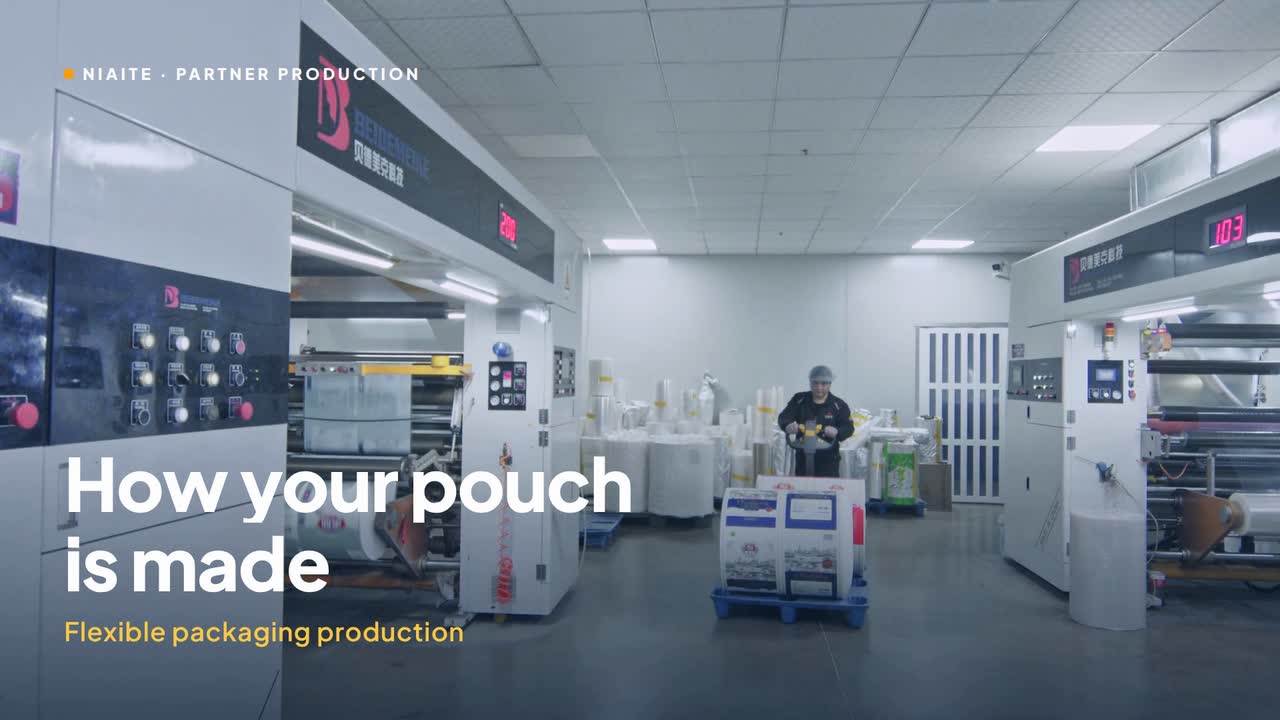
Printing, slitting and pouch conversion running on our own production floor: a custom pouch job after the buyer approved structure and artwork.
How Are Pouches Checked, Packed and Shipped?
Before production, agree the inspection scope and any documentation you want to see. NIAITE confirms these requirements with the factory running your job. Packing details (pouches per bundle, carton type, pallet pattern) also need to be stated if your warehouse or filling line has requirements.
The agreed Incoterms® rule (see the ICC Incoterms® rules) allocates specified transport costs, delivery obligations and risk of loss or damage between buyer and seller. State the rule, the named place or port and the Incoterms® version in the contract. The domestic vs overseas sourcing guide covers what else to verify.
When Might Stock Pouches With Labels Be a Better Starting Point?
If your product, fill weight or artwork is still changing, consider stock pouches with labels as an interim option. This avoids committing to a custom-printed film run while those details remain unsettled; see stock bags with labels vs custom printed pouches. How the print route relates to minimums is covered in MOQ by bag style.
The delivered quantity may be higher or lower than the quantity ordered; the acceptable range is agreed before production, and overruns and underruns explains what to agree. New to the vocabulary? The flexible packaging glossary defines the terms used here.
Frequently Asked Questions
Do all custom printed pouches follow the same process?
No. The route depends on the film structure, print method, pouch format and required features. Digital printing has no cylinder or plate stage, extrusion lamination differs from adhesive lamination, and roll stock stops after slitting.
Why can't printing start as soon as an order is placed?
Printing depends on approved artwork, a confirmed structure and, for gravure or flexo, cylinders or plates made from the approved files. A missing approval holds up the stages after it.
Why does an adhesive-laminated pouch need curing time?
Reactive laminating adhesives need time to develop their properties. The conditions for slitting, pouch conversion and final use depend on the adhesive system and structure, and should be confirmed for the project.
Can I change the artwork after approval?
Ask whether production has started before requesting an artwork change. A revision may require new approval, replacement cylinders or plates, or reprinting, depending on the stage reached.
Is roll stock made differently from pouches?
Printed laminated roll stock can share the printing, lamination and slitting stages with pre-made pouches. It is supplied as rolls rather than converted into individual bags.
Who makes the pouches when I work with NIAITE?
Formats and print routes within our range run on our production floor; others are made at trusted partner factories. Either way you work with one supplier, one team: NIAITE (Neat Packaging) reviews buyer requirements and coordinates specifications, samples, proofs and project communication. If you want to know where a specific order is made, ask your project coordinator.